
Installing an EV charger in a condo in Malaysia is one of the biggest headaches for high-rise EV owners — and it doesn’t have to be. Whether you’ve just bought a BYD Atto 3, a Tesla Model Y, or a Proton eMAS 5, the first question after driving home is always the same: “Can I actually charge this thing in my parking bay?”
The short answer? Yes, you can. But unlike landed homes, condo installations involve JMB approvals, strata law compliance, and TNB metering decisions that can add weeks (or months) to the process if you don’t know what you’re doing.
This guide walks you through everything — from writing your JMB proposal to choosing between metering options, handling common objections, and claiming your RM2,500 tax relief. By the end, you’ll have a clear action plan to get your charger installed without the runaround.
Why Condo EV Charging Is Different from Landed Homes
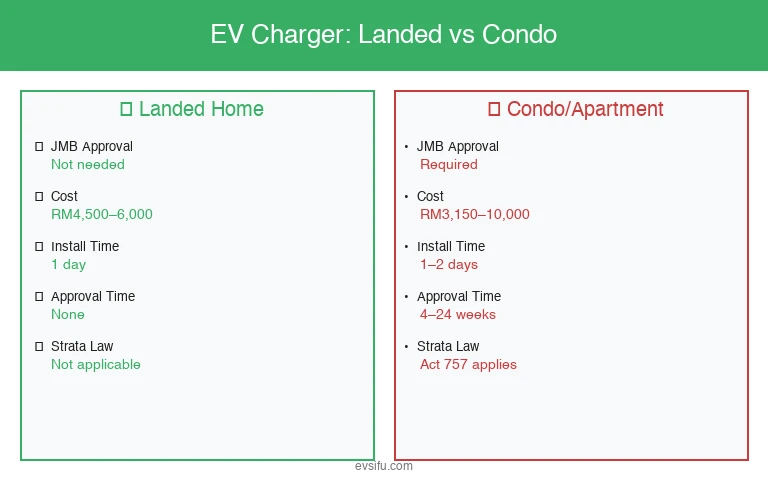
If you live in a terrace house, semi-D, or bungalow, installing an EV charger is straightforward — your electrician wires a dedicated circuit from your distribution board (DB) to your car porch, and you’re done in a day. No approvals needed. Total cost: RM4,500–6,000 for a typical 7.4kW setup.
Condos are a different story entirely. Here’s why:
- Your parking bay is common property (or a parcel accessory) under the Strata Management Act 2013
- Cables must run through common areas — riser shafts, car park ceilings, or corridors — which are under JMB/MC jurisdiction
- Electrical load sharing — your building’s power supply is shared, so adding chargers affects everyone
- Fire safety concerns — JMBs often cite fire risk as a reason to reject installations (more on why this is overblown below)
The good news: the law is on your side. Under Paragraph 13 of the Second Schedule of the Strata Management Act 2013 (Act 757), any proprietor may submit a motion for inclusion in the agenda of a general meeting by giving written notice at least 7 days before the meeting. Your JMB is legally obligated to consider your proposal. An outright ban without valid technical or safety justification can be challenged at the Strata Management Tribunal (SMT) — and the filing fee is just RM100.
ALSO READ: Complete Home EV Charging Guide Malaysia
Step-by-Step: How to Get JMB Approval for Your EV Charger
Here’s the exact process that works. Don’t skip steps — each one builds your case and reduces the chance of rejection.
Step 1: Write a Formal Proposal to Your JMB/MC
Your proposal should include:
- Your unit number and parking bay number
- Charger specifications (brand, model, power rating — e.g., 7.4kW AC)
- Cable routing plan (where cables will run from your unit/meter to your bay)
- Confirmation that a Licensed Electrical Worker (LEW) will handle all work
- TNB metering solution (from your unit meter or a new dedicated sub-meter)
- Written commitment to bear all costs and restore common areas if you move out
Pro tip: attach a one-page diagram showing the cable route. It makes your proposal look professional and reduces back-and-forth questions.
Step 2: Get a Licensed Electrical Worker (LEW) Site Assessment
Before the JMB decides, you need a professional assessment. An LEW will evaluate:
- Existing Main Distribution Board (MDB) capacity — can it handle an additional 32A circuit?
- Feasibility of new circuit breaker and wiring from your DB or a new TNB meter
- Optimal cable routes that minimize common area disruption
- TNB supply adequacy for the additional load
This assessment typically costs RM200–500 and takes 1–2 weeks. Many EV charger installers offer free site assessments — EV Sifu provides free consultation and site assessment for condo installations.
Step 3: Decide on Your TNB Metering Option
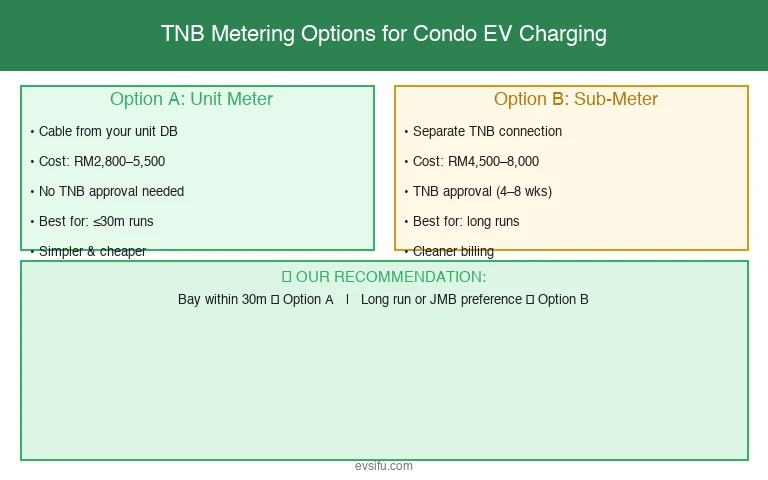
This is the biggest decision for condo owners. You have two options:
| Feature | Option A: Unit Meter | Option B: Dedicated Sub-Meter |
|---|---|---|
| How it works | Cable runs from your unit’s DB to parking bay | Separate TNB connection in car park |
| Cost | RM2,800–5,500 | RM4,500–8,000 |
| Billing | Charged to your residential tariff | Separate TNB bill |
| TNB approval | Not required | Required (4–8 weeks) |
| Best for | Bays close to your unit; simpler JMBs | Long-term use; multi-unit buildings |
| Drawback | Some JMBs resist cables in common corridors | Higher upfront cost |
Our recommendation: If your parking bay is within 30 metres of your unit’s DB, Option A is simpler and cheaper. For longer runs or if your JMB prefers cleaner separation, Option B is worth the extra cost.
Step 4: Obtain Written JMB/MC Approval
Once you’ve submitted your proposal with the LEW assessment, the JMB must respond. Key points:
- If approval requires an AGM resolution: This can take 3–6 months if the next AGM is far away
- Request an EGM (Extraordinary General Meeting): With enough co-proposers among residents, you can get an EGM called within 4–8 weeks
- Get the approval in writing — it should specify permitted cable routes, charger specs, reinstatement obligations, and access conditions
If the JMB refuses without valid technical or safety grounds, you have legal recourse through the Strata Management Tribunal (SMT).
ALSO READ: Best Home EV Charger Malaysia
Step 5: Installation & Commissioning
Once approved, the actual installation is the easy part:
- Timeline: 1–2 working days
- Your LEW installs the charger, wiring, circuit breaker, and RCD protection
- Testing and commissioning ensures everything works safely
- Certificate of Completion and Compliance (CCC) is issued by the LEW
Keep this CCC — you’ll need it for your tax relief claim and for your JMB’s records.
How Much Does It Cost to Install an EV Charger in a Condo?
Here’s a realistic cost breakdown for 2026 Klang Valley pricing:
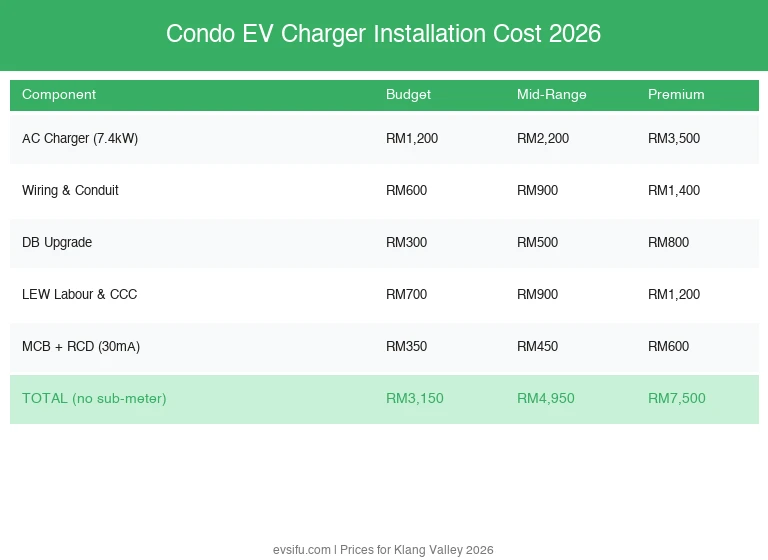
| Component | Budget | Mid-Range | Premium |
|---|---|---|---|
| AC Charger (7.4kW) | RM1,200 | RM2,200 | RM3,500 |
| Wiring & Conduit (≤30m) | RM600 | RM900 | RM1,400 |
| Distribution Board Upgrade | RM300 | RM500 | RM800 |
| LEW Labour & CCC | RM700 | RM900 | RM1,200 |
| MCB + RCD Type A (30mA) | RM350 | RM450 | RM600 |
| TNB Sub-Meter (if applicable) | — | RM1,800 | RM2,500 |
| Total (without sub-meter) | RM3,150 | RM4,950 | RM7,500 |
| Total (with sub-meter) | — | RM6,750 | RM10,000 |
Note: Prices vary based on cable run length, building complexity, and charger brand. East Malaysia and rural areas may differ.
Recommended Chargers for Condo Installation
These are popular choices among Malaysian condo owners:
| Charger | Power | Key Feature | Price (Unit Only) |
|---|---|---|---|
| Energi Elite 7kW | 7.4kW | WiFi + Bluetooth, compact | From RM1,999 |
| Energi Elite 11kW | 11kW | 3-phase, app control | From RM1,999 |
| Wallbox Pulsar Plus | 7.4kW | Ultra-compact, dynamic load balancing | RM2,800–3,200 |
| ABB Terra AC | 7.4–22kW | RFID access, IK10 impact rated | From RM3,500 |
| Schneider EVlink Home | 7.4kW | Solar optimization, premium design | RM3,500–4,200 |
| Teltonika 22kW | 22kW | European-made, 3-year warranty | From RM3,799 |
For condo installations, a 7.4kW single-phase charger is the sweet spot — it charges most EVs overnight (adding 35–50km of range per hour), uses your existing single-phase supply, and doesn’t overload the building’s electrical system.
ALSO READ: EV vs Petrol Running Cost Malaysia
Electrical & Safety Requirements You Must Know
RCD Protection (Mandatory)
Every EV charger circuit in Malaysia must have a Residual Current Device (RCD) rated at 30mA. A Type A RCD is the minimum requirement for EV charger circuits. This protects against electrical faults and is non-negotiable.
Cable Sizing
- 7.4kW (32A): Minimum 6mm² copper cable
- 11kW and above: Minimum 10mm² copper cable
Enclosure Rating
Your charger must be rated at least IP54 for car park environments — this means it’s protected against dust and water splashes. Most quality chargers meet this standard.
SIRIM Certification
All EV chargers legally sold in Malaysia must carry SIRIM QAS certification and comply with MS IEC 61851 standards. Always check for the SIRIM label before purchasing — uncertified chargers void your insurance coverage and can’t be used for tax relief claims.
Fire Safety — Let’s Address the Elephant in the Room
This is the number one reason JMBs reject EV charger installations. Here are the actual statistics from Jabatan Bomba:
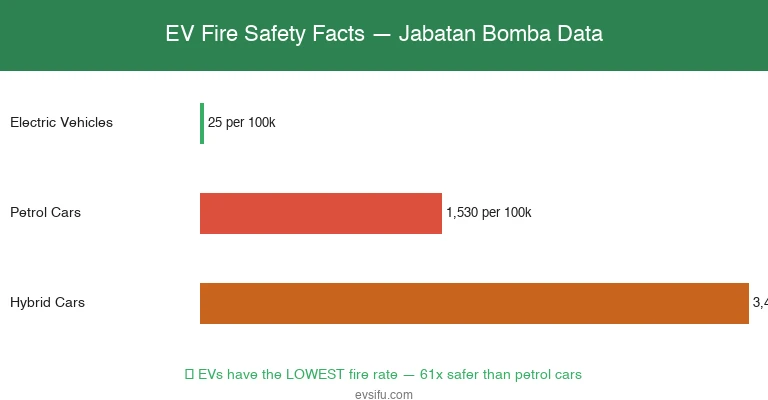
| Vehicle Type | Fire Incidents per 100,000 Vehicles |
|---|---|
| Electric vehicles | 25 |
| Petrol (gasoline) cars | 1,530 |
| Hybrid cars | 3,475 |
EVs have the lowest fire rate at 25 per 100,000 vehicles — compared to 1,530 for petrol and 3,475 for hybrids. The real fire risk comes from improper installation — not from the charger or the EV itself. This is precisely why using a licensed LEW and SIRIM-certified equipment matters.
No specialised “EV fire insurance” exists because standard building insurance already covers electrical fires regardless of the source. Present these statistics to your JMB if fire safety comes up as an objection.
Common JMB Objections — And How to Counter Them
| Objection | Your Response |
|---|---|
| “Fire risk is too high” | EVs have the lowest fire rate: 25 per 100k vs 1,530 petrol, 3,475 hybrid (Bomba data). Risk comes from improper installation, which is why you’re using a licensed LEW with SIRIM-certified equipment. |
| “It will overload the building’s power” | A single 7.4kW charger draws the same as 2–3 air conditioners. LEW assessment confirms supply adequacy. |
| “Other residents will object” | Under Paragraph 13, Second Schedule of the Strata Management Act 2013 (Act 757), any proprietor may submit a motion at a general meeting with 7 days’ written notice. Unreasonable refusal can be challenged at SMT (RM100 filing fee). |
| “We don’t have a policy for this” | Offer to help draft one. A building-wide EV charging policy adds property value and prepares the building for the future. |
| “Insurance won’t cover it” | Standard building insurance covers electrical fires. No insurer excludes certified EV charger installations. |
Pro tip: If you know other EV owners in your building, submit a joint proposal. A group request carries more weight and can justify building-wide infrastructure investment.
Claim Your RM2,500 Tax Relief
Malaysian EV owners can claim a personal tax relief of up to RM2,500 for EV charging facility expenses. This has been extended through Year of Assessment 2027 (filing in 2028).
What’s Covered
- Purchase cost of the wallbox/charger
- Installation costs (labour and wiring)
- Hire-purchase instalments
- Monthly subscription fees (Charger-as-a-Service models)
How to Claim
- Keep all receipts and invoices for 7 years (LHDN requirement)
- Request an itemised invoice from your installer — if it just says “EV Charger Package — RM2,500,” LHDN may question the breakdown
- During e-filing, look for the “Electric vehicle charging facility” section
- Digital receipts from charging apps count — download and save them
ALSO READ: EV Road Tax Malaysia 2026 — Rates & Exemptions
Condo vs Landed: Quick Comparison
| Factor | Landed Home | Condo/Apartment |
|---|---|---|
| JMB approval needed? | No | Yes |
| Typical cost | RM4,500–6,000 | RM3,150–10,000 |
| Installation time | 1 day | 1–2 days (after approval) |
| Approval timeline | None | 4–24 weeks |
| TNB sub-meter option | Usually not needed | Often recommended |
| Strata law applies? | No | Yes (Act 757) |
What About Shared/Community Chargers?
Some condos are now installing shared EV chargers managed by the JMB or a third-party operator. If your building is considering this route:
- Shared chargers require ST (Energy Commission), Bomba, and Majlis Perbandaran approvals — unlike private installations
- A dedicated Electric Vehicle Distribution Board (EVDB) per parking level is recommended for scalability
- Dynamic load balancing prevents the building’s power supply from being overwhelmed
- RFID access control and app-based billing solve the “who pays?” problem
- A good starting ratio is 1 charger per 10 EV owners, scaling up as demand grows
This is a great option if your JMB is progressive — it adds property value and attracts EV-savvy buyers/tenants.
👉 Need help planning condo EV charging infrastructure? Contact EV Sifu for a free consultation.
Frequently Asked Questions (FAQ)
Can I install an EV charger in my condo parking bay in Malaysia?
Yes, you can install a private EV charger at your assigned condo parking bay. You need written approval from your JMB or Management Corporation (MC) and must use a Licensed Electrical Worker (LEW) for installation. Under Paragraph 13 of the Second Schedule of the Strata Management Act 2013 (Act 757), any proprietor may submit a motion at a general meeting. Unreasonable refusal can be challenged at the Strata Management Tribunal.
How much does it cost to install an EV charger in a Malaysian condo?
Costs range from RM3,150 (budget setup with a basic 7.4kW charger) to RM10,000+ (premium charger with dedicated TNB sub-meter). The average mid-range installation costs around RM5,000–6,500. This includes the charger unit, wiring, circuit protection, and LEW labour.
Do I need Bomba (fire department) approval for a private EV charger in my condo?
No. Private EV chargers at your own parking bay do not require Bomba or local council (Majlis) approval — only JMB/MC consent and proper installation by a licensed electrician. Bomba and Majlis approvals are only required for public or communal chargers open to multiple users.
How long does it take to get JMB approval for an EV charger?
The timeline varies. If approval can be granted by the management committee directly, it may take 2–4 weeks. If it requires an AGM resolution, expect 3–6 months depending on when the next AGM is scheduled. You can request an EGM with support from other residents, which typically takes 4–8 weeks.
Can my JMB refuse to let me install an EV charger?
Your JMB can raise concerns, but under the Strata Management Act 2013 (Act 757), they cannot unreasonably refuse without valid technical or safety justification. If they refuse without proper grounds, you can file a dispute at the Strata Management Tribunal (SMT) for just RM100. Common excuses like “fire risk” can be countered with Bomba statistics showing EVs have the lowest fire rate: 25 per 100k vehicles.
Should I use my unit’s electricity meter or install a dedicated TNB sub-meter?
If your parking bay is within 30m of your unit and your JMB permits cables through common areas, using your unit meter (Option A, RM2,800–5,500) is simpler and cheaper. For longer distances or if you want clean billing separation, a dedicated TNB sub-meter (Option B, RM4,500–8,000) is the better long-term choice. The sub-meter requires TNB approval, which takes 4–8 weeks.
What type of EV charger is best for condos in Malaysia?
A 7.4kW single-phase AC charger is ideal for most condo installations. It adds 35–50km of range per hour, charges most EVs fully overnight, uses standard single-phase power (no expensive three-phase upgrade needed), and draws about the same power as 2–3 air conditioners. Brands like Energi Elite, Wallbox Pulsar Plus, and ABB Terra AC are popular choices.
Can I claim tax relief for my condo EV charger installation?
Yes. You can claim up to RM2,500 in personal tax relief for EV charging facility expenses, including the charger purchase, installation costs, and hire-purchase payments. This relief is available through Year of Assessment 2027. Keep itemised invoices for 7 years and file under the “Electric vehicle charging facility” section on LHDN e-filing.
Conclusion
Installing an EV charger in your Malaysian condo is absolutely doable — it just requires more planning than a landed home. The process boils down to: write a solid JMB proposal, get an LEW assessment, choose your metering option, secure written approval, and install.
The law supports you (Strata Management Act 2013, Act 757), the safety data backs you up (EVs have the lowest fire rate at 25 per 100k vehicles), and the government incentivises you (RM2,500 tax relief through 2027). The only real obstacle is navigating the JMB process — and now you have the playbook.
Don’t forget: as more Malaysians switch to EVs, condos with charging infrastructure will command higher property values. You’re not just solving your own charging problem — you’re adding value to your building.
👉 Ready to install? Visit evsifu.com.my to browse EV chargers from RM1,999 and get a free condo site assessment. WhatsApp EV Sifu at +60128873023 for a quick consultation.
ALSO READ: Cheapest EV in Malaysia 2026