
Imagine plugging in your car every night and waking up to a full battery — no queuing at petrol stations, no detours to public chargers. EV charging at home in Malaysia is now cheaper and easier than ever, with a full charge on the Proton e.MAS 5 costing as low as ~RM13 on the new TNB flat tariff. Whether you drive a Perodua QV-E, a BYD Dolphin, or a Tesla Model Y, this guide walks you through every step — from choosing the right charger to managing your electricity bill.
By the end, you will know exactly what equipment to buy, how much installation costs, and how to keep your monthly charging bill under RM100 for most EVs.
Why Charge at Home? The Numbers Speak for Themselves
Home charging is the most convenient and cost-effective way to keep your EV topped up. Here is how it compares to public charging and petrol:
| Charging Method | Cost per kWh | Full Charge (30 kWh, e.MAS 5) | Monthly Cost (~214 kWh) |
|---|---|---|---|
| Home (TNB flat rate) | RM0.4443 | ~RM13 | ~RM95 |
| Public AC (ChargEV/JomCharge) | RM1.00–RM1.20 | RM30–RM36 | RM214–RM257 |
| Public DC Fast Charging | RM1.20–RM1.80 | RM36–RM54 | RM257–RM385 |
| Petrol (Proton X50, BUDI95) | — | ~RM50 equivalent range | ~RM400+ |
The savings are clear. Home charging at 44.43 sen/kWh costs roughly one-third of public AC charging and a fraction of what you would spend on petrol.
ALSO READ: EV vs Petrol Running Cost Malaysia — Full 2026 Comparison
Step 1: Choose Your Charger — 7kW vs 11kW vs 22kW
The first decision is charger speed. Most Malaysian homes run on single-phase power, which limits you to 7kW. If your home has three-phase supply, you can go up to 22kW.
7kW AC Charger (Single-Phase)
This is the most common choice for Malaysian homes. A 7kW charger uses a standard single-phase 32A supply and can fully charge most EVs overnight.
| EV Model | Battery Size | 7kW Charge Time (0–100%) |
|---|---|---|
| Proton e.MAS 5 | 30 kWh | ~4.5 hours |
| Perodua QV-E | 52.5 kWh | ~7.5 hours |
| BYD Dolphin | 44.9 kWh | ~6.5 hours |
| Tesla Model Y | 60 kWh | ~8.5 hours |
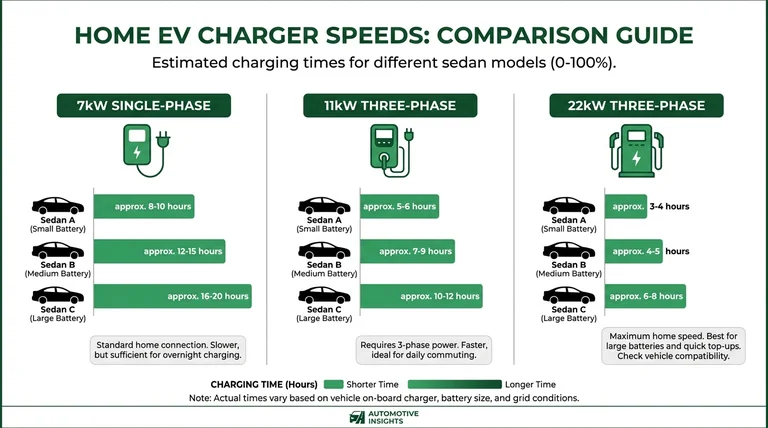
For most drivers who plug in after work and leave by morning, 7kW is more than sufficient. You get 8–10 hours of charging overnight, which is enough even for the largest batteries.
11kW AC Charger (Three-Phase)
If your home already has a three-phase supply (common in larger semi-D and bungalow homes), an 11kW charger cuts charging time by about 35%. The Proton e.MAS 5 goes from empty to full in roughly 3 hours, while the Perodua QV-E with its 370 km WLTP range takes about 4 hours.
22kW AC Charger (Three-Phase)
The fastest home AC option. However, most EVs sold in Malaysia only accept 7kW or 11kW on their onboard charger. The Proton e.MAS 5, for example, maxes out at 6.6kW AC. A 22kW charger future-proofs your setup, but check your car’s onboard charger limit before investing.
Pro Tip: The charger can only deliver power as fast as your car’s onboard charger accepts it. A 22kW wall charger plugged into an e.MAS 5 will still charge at 6.6kW.
ALSO READ: Best Home EV Charger Malaysia 2026 — Top Picks & Prices
Step 2: Total Cost of Home EV Charger Installation
Here is a realistic budget breakdown for a complete home charger installation in Malaysia.
Equipment Cost
Charger prices vary by brand, power rating, and features. These are actual chargers available on evsifu.com.my:
| Charger | Power | Price From | Key Features |
|---|---|---|---|
| Feyree | 7kW | ~RM1,088 | Budget-friendly, compact, Type 2 |
| Feyree | 11kW | ~RM1,288 | Three-phase, app control |
| Feyree | 22kW | ~RM1,188 | Three-phase, fast AC charging |
| Energi Elite E1/E1.1 Series | 7kW | ~RM1,999 | Smart features, RFID, Type 2 |
| Energi Elite E1/E1.1 Series | 11kW | ~RM2,499 | Three-phase, load balancing |
| Energi Elite E1/E1.1 Series | 22kW | ~RM2,899 | Full-speed three-phase |
| E8 Universal Charger | 7kW/22kW | ~RM1,999 | Universal compatibility |
| Teltonika TeltoCharge | 7kW/11kW/22kW | ~RM3,899 | Premium build, OCPP, smart energy management |
For most homeowners, a 7kW Feyree at ~RM1,088 or an Energi Elite E1 at ~RM1,999 is the sweet spot between price and features.
Installation Cost
| Component | Estimated Cost |
|---|---|
| Charger unit | RM1,088–RM3,899 |
| Wiring & cabling (10–15m typical) | RM300–RM800 |
| MCB/RCCB protective devices | RM200–RM500 |
| TNB meter upgrade (if needed) | RM200–RM500 |
| Licensed electrician labour | RM300–RM800 |
| Total | ~RM2,100–RM6,500 |
Most landed home installations fall in the RM2,500–RM4,000 range for a complete 7kW setup including a mid-range charger.
Budget Option: A Feyree 7kW charger with basic installation can come in under RM2,100 total — making home charging accessible to most EV owners.
ALSO READ: EV Charger Installation Malaysia — Condo vs Landed Guide
Step 3: Installation Process — 6 Steps
Step 3.1: Site Assessment
Before buying anything, have a licensed electrician assess your home. They will check:
- Existing electrical capacity — Is your main supply 60A or 100A? A 7kW charger draws about 32A, so you may need a meter upgrade.
- Distance from DB (distribution board) to parking — Longer cable runs cost more.
- Phase type — Single-phase (most terrace houses) or three-phase (some semi-D/bungalows).
- Wall mounting location — The charger needs a sturdy, weatherproof spot near your parking area.
Most electricians offer free or low-cost site assessments. Get at least two quotes.
Step 3.2: TNB Meter Upgrade (If Required)
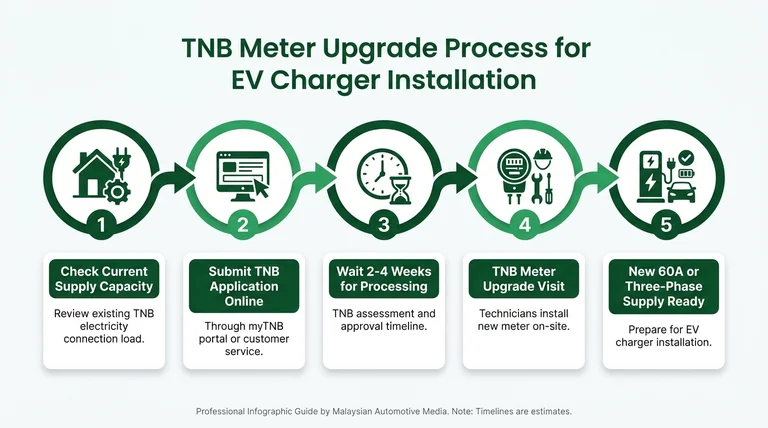
If your current TNB supply is below 60A single-phase, you will need an upgrade. For a 7kW charger, a 60A single-phase supply is sufficient. For 11kW or 22kW, you need three-phase supply.
Apply through the TNB portal or visit a TNB branch. Processing typically takes 2–4 weeks. The cost is RM200–RM500 depending on the upgrade type.
Step 3.3: Equipment Procurement
Purchase your charger from a trusted supplier. On evsifu.com.my, you can find chargers from Energi Elite (E1/E1.1 Series), Feyree, E8 Universal, and Teltonika TeltoCharge — all with Type 2 connectors compatible with Malaysian EVs.
When ordering, confirm:
- Power rating matches your electrical supply (7kW for single-phase, 11kW/22kW for three-phase)
- Cable length suits your parking setup (typically 5m standard)
- Smart features you need — app control, scheduled charging, energy monitoring
Step 3.4: Electrical Wiring
Your licensed electrician will:
- Install a dedicated circuit from your DB to the charger location
- Fit an MCB (Miniature Circuit Breaker) — typically 32A for 7kW
- Install an RCCB (Residual Current Circuit Breaker) for earth leakage protection — this is mandatory for safety
- Run appropriately rated cables (typically 6mm² for 7kW, 10mm² for 22kW)
All wiring must comply with MS IEC 61851 and Malaysian wiring regulations. Do not attempt DIY electrical work.
Step 3.5: Charger Mounting & Connection
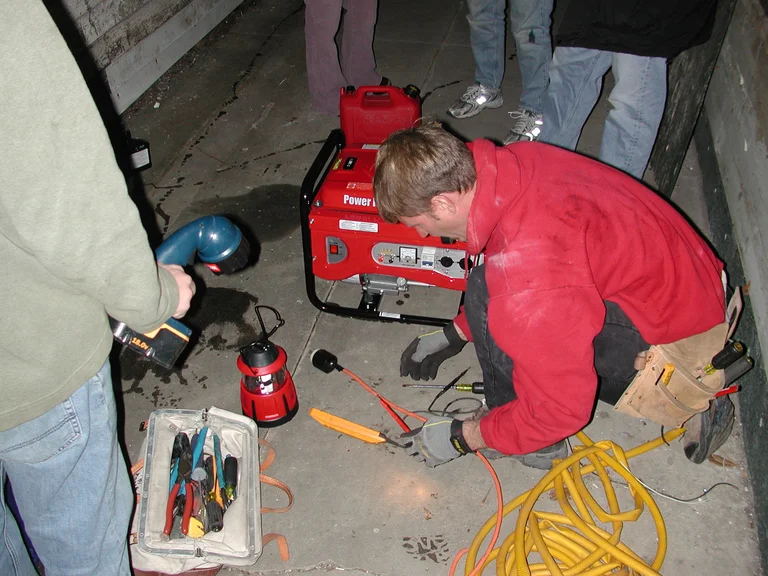
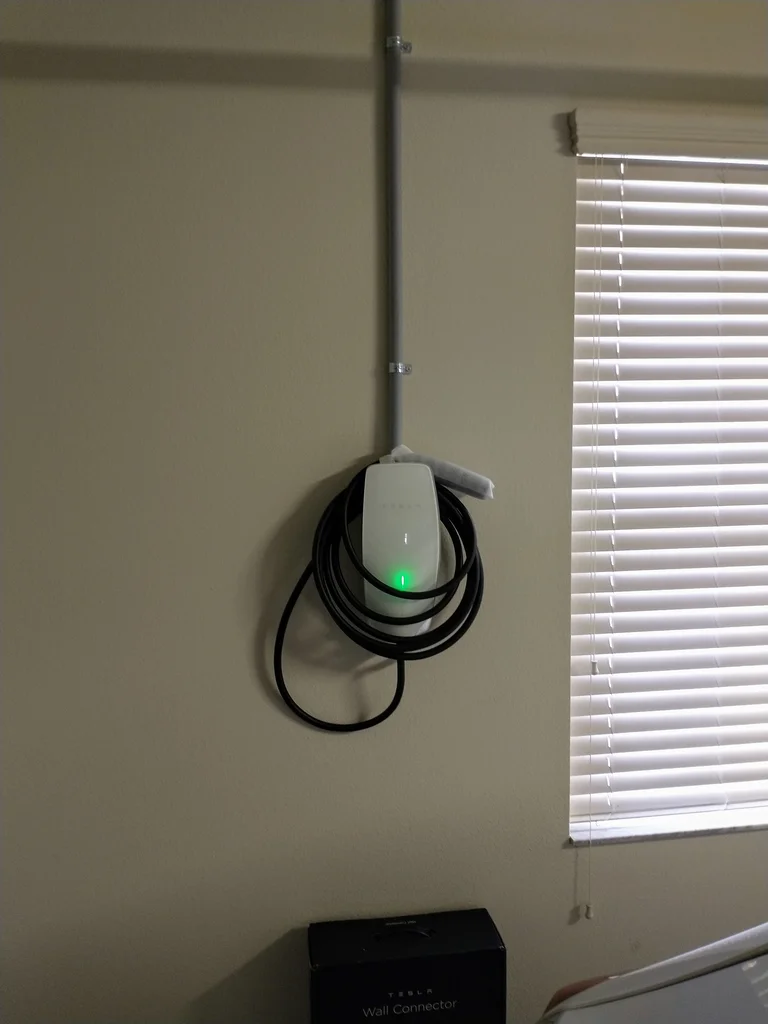
The charger is mounted on the wall (or a pedestal stand if wall mounting is not feasible) and connected to the dedicated circuit. The electrician will secure the unit at the correct height (typically 1.0–1.5m from ground), connect power cables, test earth fault protection, and verify voltage and current readings.
Step 3.6: Testing & Commissioning
Final checks include continuity testing of all connections, earth fault loop impedance test, RCD trip test (the RCCB must trip within specification), and a functional test — plug in your EV and confirm it charges correctly. Your electrician should provide a completion certificate. Keep this for your records and any future property transactions.
ALSO READ: Complete Home EV Charging Guide Malaysia 2026
Condo & Apartment EV Charger Installation
Installing a home charger in a condo or apartment is possible but requires more coordination. Here is what you need to know.
JMB/MC Approval
You must get written approval from your Joint Management Body (JMB) or Management Corporation (MC) before installation. Prepare a formal application letter, technical specifications of the charger, electrician’s installation plan, and insurance coverage details (some JMBs require this). Processing typically takes 2–8 weeks depending on the management.
Dedicated Meter
Most condos require a dedicated sub-meter for your EV charger so the electricity is billed to your unit, not the common area. This is usually installed in the parking basement near your lot.
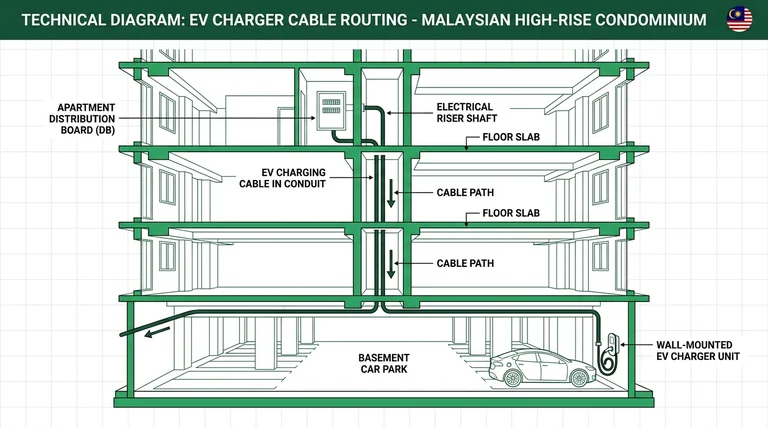
Cable Routing
The biggest challenge in condos is running cables from your unit’s DB (or a dedicated supply point) to your parking lot. Cable runs of 30–50 metres are common, which adds RM500–RM2,000 to installation costs.
Some newer condos are being built “EV-ready” with pre-wired charging points in parking bays. Check with your developer if your condo has this feature.
Condo Tip: Some management companies now offer centralised EV charging solutions where the management installs shared chargers. Ask your JMB about this option — it may be cheaper than individual installation.
Type 2 vs Type 1 Connectors — Which One for Malaysia?
Almost all EVs sold in Malaysia in 2026 use the Type 2 (Mennekes) connector for AC charging. This is the standard across Europe and Asia, and all chargers available on evsifu.com.my come with Type 2 connectors.
| Feature | Type 2 (Mennekes) | Type 1 (J1772) |
|---|---|---|
| Standard in Malaysia | Yes | No (legacy) |
| Max AC Power | 22kW (three-phase) | 7.4kW (single-phase only) |
| Used by | All current Malaysian-market EVs | Older Nissan Leaf, some US imports |
| Pins | 7 pins | 5 pins |
Bottom line: Buy a Type 2 charger. If you have an older EV with a Type 1 port, use a Type 1-to-Type 2 adapter cable.
ALSO READ: Cheapest EVs in Malaysia 2026 — Full Price Guide
How Much Will Your Electricity Bill Increase?
This is the question every EV owner asks. With the new TNB flat tariff structure effective 1 July 2025, the calculation is straightforward.
TNB Domestic Tariff (Effective 1 July 2025)
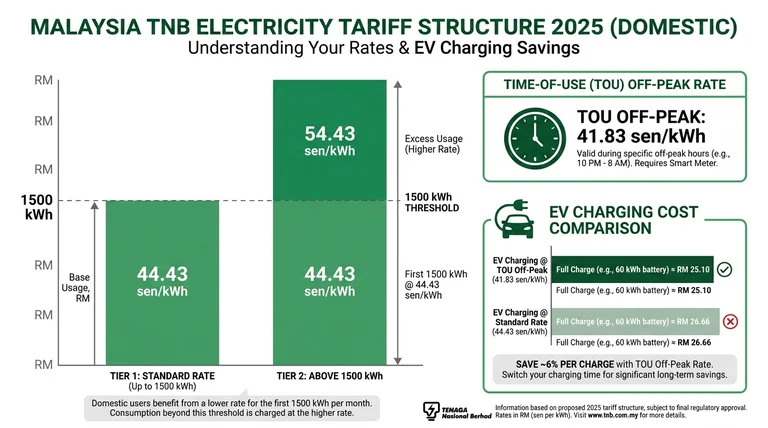
The old 5-block tiered tariff has been replaced with a simpler flat rate structure:
| Usage Tier | Rate (sen/kWh) | Breakdown |
|---|---|---|
| Standard (up to 1,500 kWh/month) | 44.43 | Energy 27.03 + Capacity 4.55 + Network 12.85 |
| Above 1,500 kWh/month | 54.43 | Higher energy component |
| ToU Off-Peak | ~41.83 | Weekdays 10pm–2pm, all day weekends |
Additional notes:
- RM10/month retail charge applies, but is waived if you use 600 kWh or less
- Efficiency incentive: Up to 25 sen/kWh rebate for households using 1,000 kWh or less total
Monthly EV Charging Bill Estimate
At the standard 44.43 sen/kWh flat rate, here is what each EV costs to charge at home based on typical monthly driving of 1,500 km:
| EV Model | Efficiency (kWh/100km) | Monthly kWh (~1,500 km) | Monthly Cost (44.43 sen/kWh) |
|---|---|---|---|
| Proton e.MAS 5 | ~14.3 | ~214 kWh | ~RM95 |
| Perodua QV-E | ~13.9 | ~208 kWh | ~RM92 |
| BYD Dolphin | ~14.7 | ~220 kWh | ~RM98 |
| Tesla Model Y | ~16.0 | ~240 kWh | ~RM107 |
Compared to Petrol
Let us compare to a similar-class petrol car doing 1,500 km/month at 12 km/litre:
- Fuel needed: 125 litres/month
- At BUDI95 RM1.99/litre (subsidised): ~RM249/month
- At unsubsidised RM3.37/litre: ~RM421/month
Even at the subsidised petrol price, charging a Proton e.MAS 5 at home saves you roughly RM154/month or RM1,848/year. Against unsubsidised petrol, the savings jump to RM326/month or RM3,912/year.
Sample Bill Impact
| Scenario | Total kWh | Monthly TNB Bill | Increase vs No EV |
|---|---|---|---|
| No EV | 400 kWh | ~RM178 | — |
| + Proton e.MAS 5 | 614 kWh | ~RM273 | +~RM95 |
| + Perodua QV-E | 608 kWh | ~RM270 | +~RM92 |
| + BYD Dolphin | 620 kWh | ~RM275 | +~RM98 |
| + Tesla Model Y | 640 kWh | ~RM284 | +~RM107 |
Money-Saving Tip: If your total household consumption stays under 1,000 kWh/month, you may qualify for TNB’s efficiency incentive of up to 25 sen/kWh rebate, which significantly reduces your bill. Smaller EVs like the e.MAS 5 make this achievable for many households.
ALSO READ: EV Road Tax Malaysia 2026 — Rates & Exemptions
7 Common Home EV Charging Mistakes to Avoid
1. Using a Regular 3-Pin Plug Long-Term
A standard 13A plug can technically trickle-charge an EV at ~2.4kW, but it is not designed for sustained high loads. Over time, this risks overheating, melted sockets, and fire. Always install a dedicated EV charger with proper circuit protection.
2. Skipping the RCCB
An RCCB (earth leakage protector) is essential for safety. Some homeowners skip it to save money — do not. A Type A RCCB rated at 30mA is the minimum requirement.
3. Undersizing the Cable
Using cable that is too thin for the charger’s current rating causes voltage drop and overheating. Your electrician should use a minimum of 6mm² for 7kW and 10mm² for 22kW installations, with adjustments for cable run length.
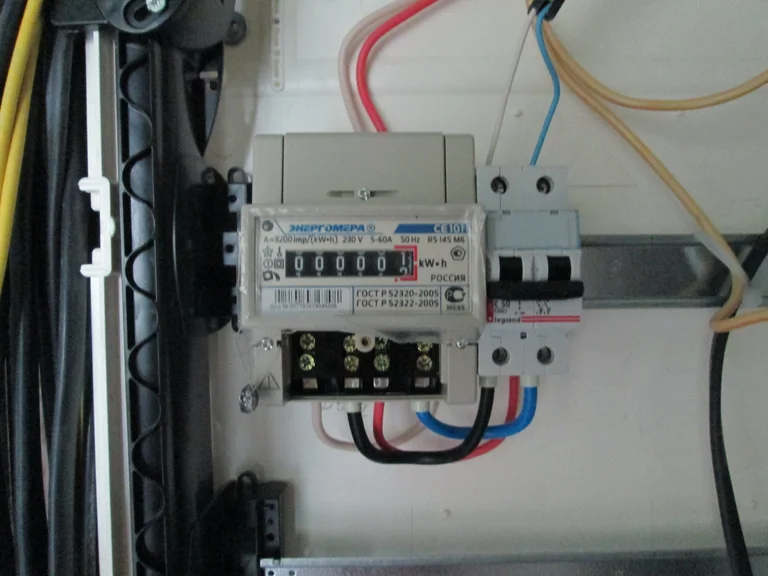
4. Not Checking Your TNB Supply
If your existing TNB supply is only 40A, adding a 32A EV charger will overload your main breaker. Always verify your supply capacity before installation and upgrade if needed.
5. Buying an Incompatible Charger
Make sure your charger has a Type 2 connector and matches your electrical supply (single-phase or three-phase). Buying from reputable Malaysian suppliers like evsifu.com.my ensures compatibility.
6. Ignoring Smart Charging Features
Smart chargers with scheduled charging and energy monitoring let you charge during off-peak hours and track your consumption. The Energi Elite E1 Series and Teltonika TeltoCharge both offer app-based scheduling — a worthwhile investment that pays for itself in lower bills.
7. DIY Electrical Work
EV charger installation involves high-current wiring that must comply with Malaysian electrical standards. Always use a licensed electrician (with a valid Suruhanjaya Tenaga wireman licence). The cost of professional installation is a small price for safety and compliance.
Frequently Asked Questions
How much does it cost to charge an EV at home in Malaysia?
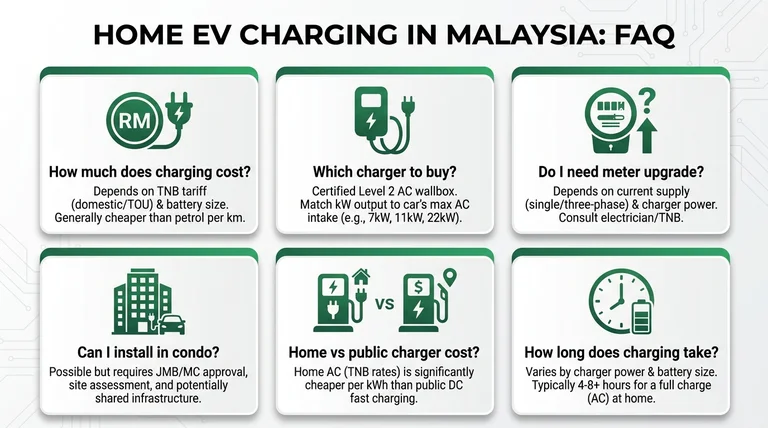
At the current TNB flat rate of 44.43 sen/kWh, a full charge of the Proton e.MAS 5 (30 kWh battery) costs approximately RM13. Monthly charging for typical driving of 1,500 km ranges from ~RM92 (Perodua QV-E) to ~RM107 (Tesla Model Y).
What is the cheapest home EV charger in Malaysia?
The Feyree 7kW charger starts from ~RM1,088 on evsifu.com.my, making it one of the most affordable options. For more features like RFID and smart app control, the Energi Elite E1 Series starts from ~RM1,999.
Do I need to upgrade my TNB meter for an EV charger?
It depends on your current supply. A 7kW charger requires at least a 60A single-phase supply. If your supply is lower, you will need a TNB meter upgrade costing RM200–RM500. For 11kW or 22kW chargers, you need a three-phase supply.
Can I install an EV charger in a condo?
Yes, but you need JMB/MC approval first. You will also need a dedicated sub-meter for billing. Cable routing from your unit to the parking bay adds to installation costs. Allow 2–8 weeks for the approval process.
Is it cheaper to charge at home or at a public charger?
Home charging is significantly cheaper. At 44.43 sen/kWh (home) versus RM1.00–RM1.80/kWh (public), you save 55–75% by charging at home. A full e.MAS 5 charge costs ~RM13 at home versus RM30–RM54 at public chargers.
How long does it take to charge an EV at home?
With a 7kW home charger, the Proton e.MAS 5 (30 kWh) charges fully in about 4.5 hours. Larger batteries like the Tesla Model Y (60 kWh) take about 8.5 hours — still well within overnight charging time.
What is TNB’s Time-of-Use (ToU) tariff for EV charging?
TNB offers a ToU off-peak rate of ~41.83 sen/kWh during weekdays 10pm to 2pm and all day on weekends. Since most home EV charging happens overnight, you can take advantage of this lower rate to save even more.
Conclusion — Start Charging at Home Today
Home EV charging in Malaysia has never been more accessible or affordable. With chargers starting from just ~RM1,088 and monthly charging costs as low as ~RM92, the switch from petrol makes financial sense from day one.
Here is your action plan:
- Check your TNB supply — Verify you have at least 60A single-phase for a 7kW charger
- Choose your charger — Browse the full range on evsifu.com.my:
- Budget: Feyree 7kW from ~RM1,088
- Mid-range: Energi Elite E1/E1.1 Series from ~RM1,999
- Premium: Teltonika TeltoCharge from ~RM3,899
- Get installation quotes — Contact at least two licensed electricians
- Install and start saving — At 44.43 sen/kWh, you will save RM150–RM300+/month compared to petrol
Whether you drive a Proton e.MAS 5, a Perodua QV-E, or any other EV on Malaysian roads, home charging is the smartest investment you can make. Stop overpaying at public chargers — browse EV chargers on evsifu.com.my today and take the first step toward hassle-free, affordable home charging.
ALSO READ: Best Home EV Charger Malaysia 2026 — Top Picks & Prices